CATEGORIES


ABOUT TALEBIBLIA

Talebiblia is a fan site devoted to Nassim Nicholas Taleb, created by Smiljana Skiba. It features a compilation of Taleb's most intriguing social media screenshots and interviews for readers to enjoy and explore. The website provides a resource for anyone looking to gain insights into Taleb's works, whether they are a dedicated reader or a curious newcomer.

Please note that Talebiblia is an independent website and is not affiliated with Nassim Nicholas Taleb in any manner.

Many thanks to Lucia Simeoni and Ashok Atluri for their invaluable assistance in creating and maintaining this website.

To stay up to date with Talebiblia's latest developments, follow Smiljana on Twitter @MasaSkiba

All the education in the world will not compensate for a logical fallacy, of the style: “All members of the Smith family are tall; he is tall *hence* he is a member of the Smith family”, the central error in Fooled by Randomness (and the main reason for underestimation of luck). — For, I am unhappy to report, many people make it in real life, along with its variations. Further, this is not just journalism: I saw it made just so frequently by PhDs (in the GMO and Pinker debates) that I am totally disgusted: better be a truck driver with logical abilities, than a PhD with such elementary defects. Indeed it is so prevalent in social science it is not even funny. — Finally, I find it horrifying that people make it here on this page (these people are now gone). Forget all the complicated stuff, focus on the elementary, the basic, for Baal’s sake. https://en.wikipedia.org/wiki/Affirming_the_consequent

LINDY FOR THE DETECTION of MODERN BULLSHIT. It is a (sort of) truism that we make the mistake of thinking of the past in terms entire made in the present, making the mistake of propagating backwards such notions as “religion”, “values”, “Gods”, “success”, “happiness”, “ambition”, “meaning of life”, and attribute it to motives of action, when these either didn’t mean much for people in the middle ages and antiquity or had different significance for them. For instance, for Semites, religion meant “law”, didn’t have the spiritual dimension we attribute today; it didn’t care of the notion of “belief” (and Christianity didn’t have a word for it other than “trust”). For pagans, Gods were cultural artifacts… For Romans, freedom meant not being a slave and *having no debt*. — What I am now trying to do, in a systematic way, is the opposite operation, that is, to reexpress the present entirely in terms that an ancient person would have grasped, that is, to propagate the mentality forward, while incorporating modern gains in ethics such as “equality”, social justice, etc. — So using Lindy as a bullshit detection mechanism, I can eliminate modern notions such as “success”, “achievement”, etc., those that do not have a moral dimension.

Rest in Peace, Jacques Le Goff, Medieval Historian, Luminous Mind. — He is the author of this passage on the contrast between the true scholar and the professor: “There is nothing more striking than the contrast between images which show the intellectual in the Middle Ages and the humanist at work. The former is a professor, caught up in his teaching (…) The other is a solitary scholar, in his calm chamber, at ease in the midst of the private, luxurious room where his thoughts can move freely about. The former shows the tumult of schools, the dust of classrooms, the collective worker’s indifference to beauty, The latter shows all is order and beauty, Luxe calme et volupté” I wish you eternal “Luxe calme et volupté”, Jacques Le Goff.

GREED-PROOF NOT GREED-FREE: Two millennia ago, Sallust wrote the following: “When I was a callow young man, I plunged enthusiastically into public life. Instead of modesty, brazenness flourished; instead of self-restraint, bribery; instead of merit, avarice (…)my youthful weakness was corrupted and gripped by ambition. Although I refrained from the wicked ways of the rest, still the same craving for advancement that plagued them with ill-repute and jealousy plagued me too.”(Bell. Cat., III.3) — 22 centuries from now (if we make it), someone will be writing the same. Yet we hear utopianizing idiots (such as the maker of the movie “Inside Jobs”) bemoaning the “greed” of bankers, the bureaucratizing minds of bureaucrats, not realizing that these are embedded in human nature. Anyone who think we can correct humans is similar to those who think that they will get it right “the next time”… ANTIFRAGILE-The only strategy for us is to build a greed-resistant system… or go further benefit from the greed of humans. And build systems in which politicians are harmless. http://uq.edu.au/hprcflex/lt2310/sallust1.htm

LARGE CITIES The adage “magna civitas magna solitudo” (big city, big solitude) started in Arcadia, referring to a “large” city that would be smaller than today’s small towns. Not Sao Paulo. — I grew up in Beirut and lived in big cities. Always depressed me to realize I was a number. For >20 years I have been living in a suburban village in the US and in a village in Lebanon. Haven’t slept in Beirut in 6 years. Nothing better than take a walk in the evening and running into faces you know every day. All my writings have been done in villages.

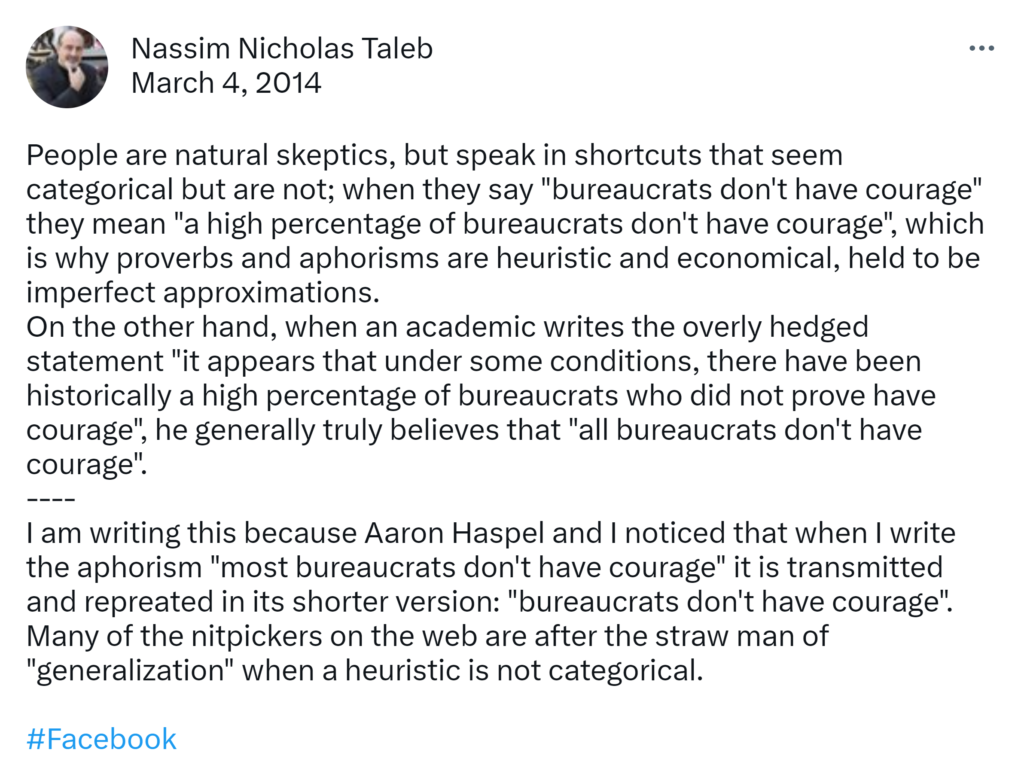
People are natural skeptics, but speak in shortcuts that seem categorical but are not; when they say “bureaucrats don’t have courage” they mean “a high percentage of bureaucrats don’t have courage”, which is why proverbs and aphorisms are heuristic and economical, held to be imperfect approximations. On the other hand, when an academic writes the overly hedged statement “it appears that under some conditions, there have been historically a high percentage of bureaucrats who did not prove have courage”, he generally truly believes that “all bureaucrats don’t have courage”. —- I am writing this because Aaron Haspel and I noticed that when I write the aphorism “most bureaucrats don’t have courage” it is transmitted and repreated in its shorter version: “bureaucrats don’t have courage”. Many of the nitpickers on the web are after the straw man of “generalization” when a heuristic is not categorical.

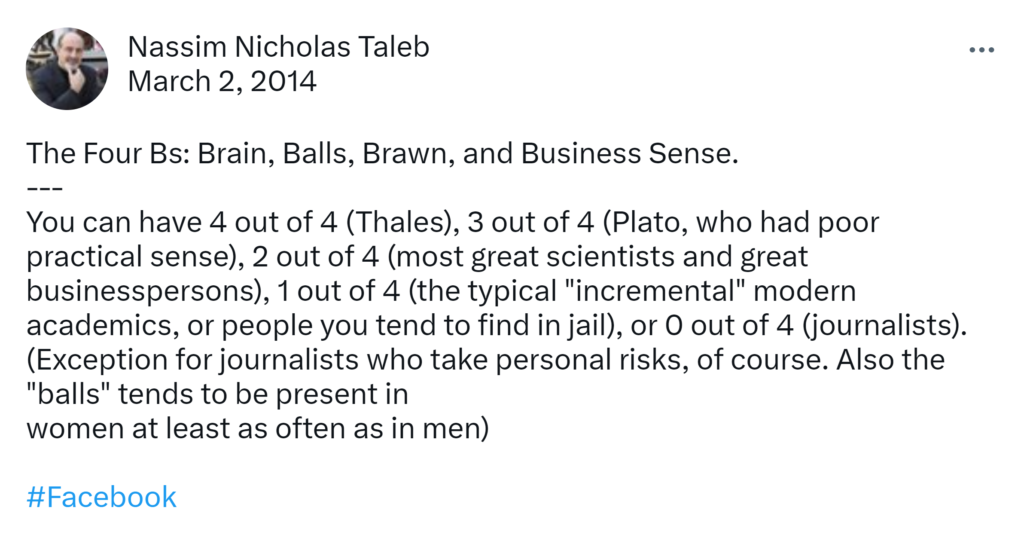
The Four Bs: Brain, Balls, Brawn, and Business Sense. — You can have 4 out of 4 (Thales), 3 out of 4 (Plato, who had poor practical sense), 2 out of 4 (most great scientists and great businesspersons), 1 out of 4 (the typical “incremental” modern academics, or people you tend to find in jail), or 0 out of 4 (journalists). (Exception for journalists who take personal risks, of course. Also the “balls” tends to be present in women at least as often as in men)

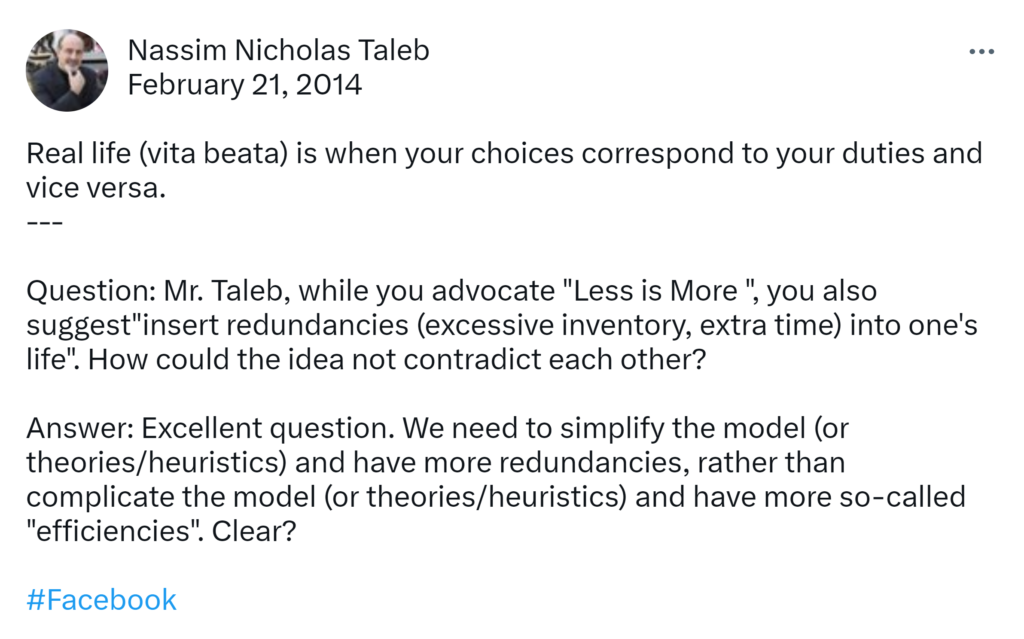
Real life (vita beata) is when your choices correspond to your duties and vice versa. — Question: Mr. Taleb, while you advocate “Less is More “, you also suggest”insert redundancies (excessive inventory, extra time) into one’s life”. How could the idea not contradict each other? Answer: Excellent question. We need to simplify the model (or theories/heuristics) and have more redundancies, rather than complicate the model (or theories/heuristics) and have more so-called “efficiencies”. Clear? #Facebook