CATEGORIES


ABOUT TALEBIBLIA

Talebiblia is a fan site devoted to Nassim Nicholas Taleb, created by Smiljana Skiba. It features a compilation of Taleb's most intriguing social media screenshots and interviews for readers to enjoy and explore. The website provides a resource for anyone looking to gain insights into Taleb's works, whether they are a dedicated reader or a curious newcomer.

Please note that Talebiblia is an independent website and is not affiliated with Nassim Nicholas Taleb in any manner.

Many thanks to Lucia Simeoni and Ashok Atluri for their invaluable assistance in creating and maintaining this website.

To stay up to date with Talebiblia's latest developments, follow Smiljana on Twitter @MasaSkiba

There are two myths that prevail in academic circles (hence the general zeitgeist) because of mental contagion and confirmatory effects (simply from the way researchers look at data and the way it is disseminated): 1) That people are overly concerned by hierarchy (and pecking order), and that hierarchy plays a real role in life, a belief generalized from the fact that *some* people care about hierarchy *most the time* (most people may care about hierarchy *some of the time* but it does not mean hierarchy is a driver). The problem is hierarchy plays a large role zero-sum environments like academia and corrupt economic regimes (meaning someone wins at the expense of others) so academics find it natural so they tend to see it in real life and environments where if may not be prevalent. Many many people don’t care and there is no need to pathologize them as “not motivated” –academics who publish tend to be “competitive” and “competitive” in a zero-sum environment is deadly. I haven’t seen any study looking at things the other way. 2) That “competition” plays a large role compared to *cooperation* in evolutionary settings –of course if you want ruthless competition you will find examples and can model it with bad math. The latter point is extremely controversial, Wilson and Nowak have been savagely attacked for their papers (with >130 signatures contesting it) and, what is curious NOBODY was able to debunk the math (very very very rigorous backup material). If Nowak/Wilson were wrong someone would have shown where, and in spite of the outpour of words nobody did. (Hint: whenever I see “math” with linear regression, my BS-detector gets fired up. See commentary on “scientists” and regression in SILENT RISK)

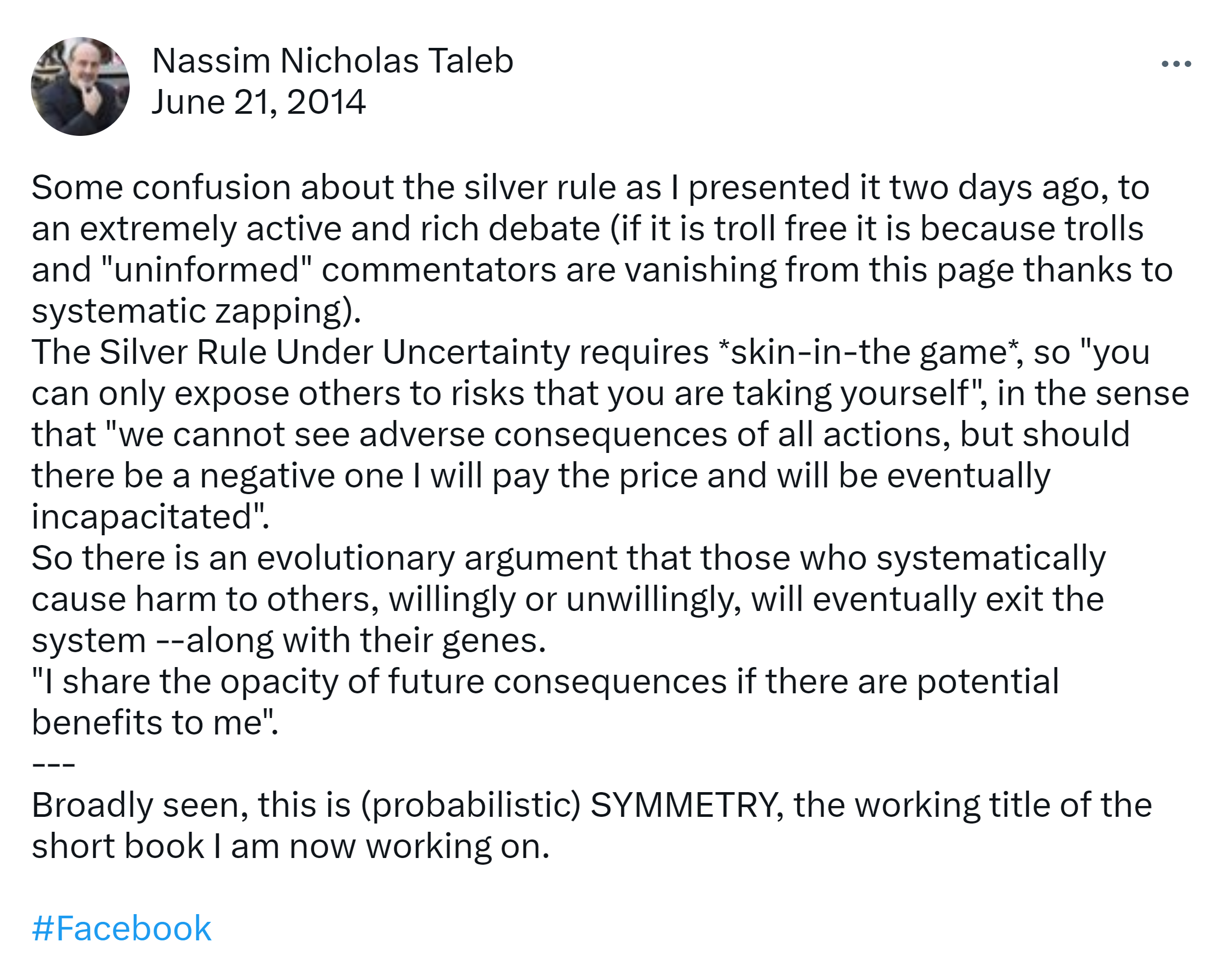
Some confusion about the silver rule as I presented it two days ago, to an extremely active and rich debate (if it is troll free it is because trolls and “uninformed” commentators are vanishing from this page thanks to systematic zapping). The Silver Rule Under Uncertainty requires *skin-in-the game*, so “you can only expose others to risks that you are taking yourself”, in the sense that “we cannot see adverse consequences of all actions, but should there be a negative one I will pay the price and will be eventually incapacitated”. So there is an evolutionary argument that those who systematically cause harm to others, willingly or unwillingly, will eventually exit the system –along with their genes. “I share the opacity of future consequences if there are potential benefits to me”. — Broadly seen, this is (probabilistic) SYMMETRY, the working title of the short book I am now working on.

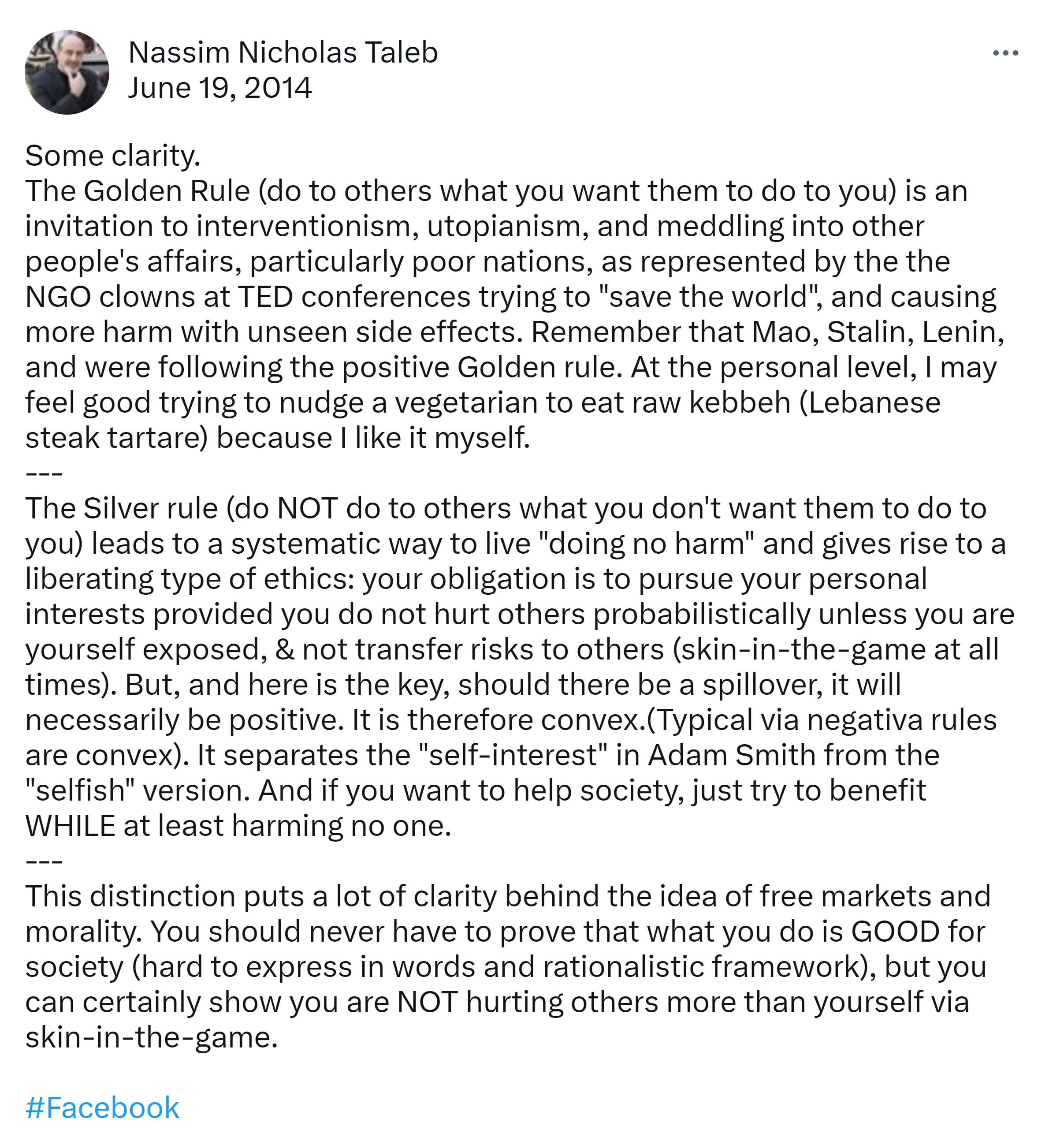
Some clarity. The Golden Rule (do to others what you want them to do to you) is an invitation to interventionism, utopianism, and meddling into other people’s affairs, particularly poor nations, as represented by the the NGO clowns at TED conferences trying to “save the world”, and causing more harm with unseen side effects. Remember that Mao, Stalin, Lenin, and were following the positive Golden rule. At the personal level, I may feel good trying to nudge a vegetarian to eat raw kebbeh (Lebanese steak tartare) because I like it myself. — The Silver rule (do NOT do to others what you don’t want them to do to you) leads to a systematic way to live “doing no harm” and gives rise to a liberating type of ethics: your obligation is to pursue your personal interests provided you do not hurt others probabilistically unless you are yourself exposed, & not transfer risks to others (skin-in-the-game at all times). But, and here is the key, should there be a spillover, it will necessarily be positive. It is therefore convex.(Typical via negativa rules are convex). It separates the “self-interest” in Adam Smith from the “selfish” version. And if you want to help society, just try to benefit WHILE at least harming no one. — This distinction puts a lot of clarity behind the idea of free markets and morality. You should never have to prove that what you do is GOOD for society (hard to express in words and rationalistic framework), but you can certainly show you are NOT hurting others more than yourself via skin-in-the-game.

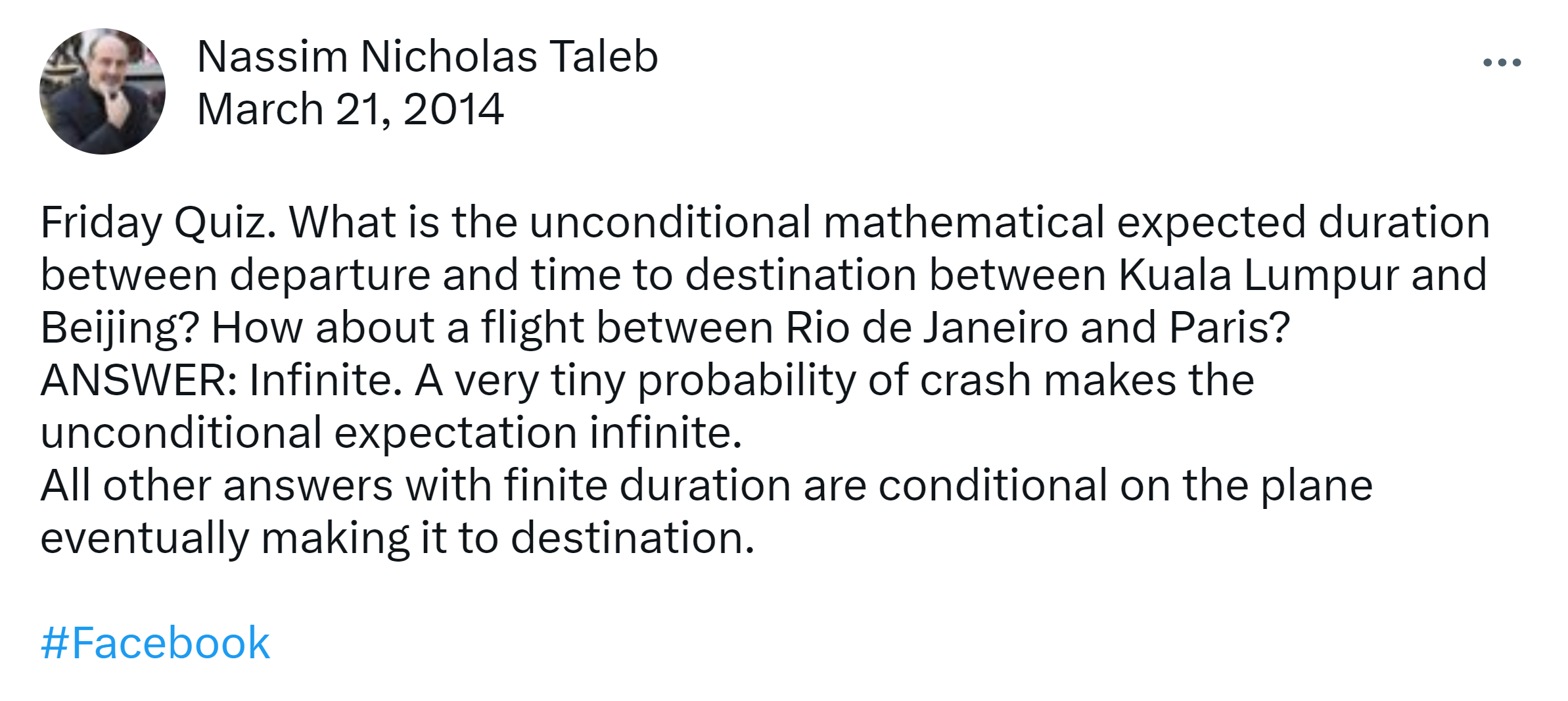
Friday Quiz. What is the unconditional mathematical expected duration between departure and time to destination between Kuala Lumpur and Beijing? How about a flight between Rio de Janeiro and Paris? ANSWER: Infinite. A very tiny probability of crash makes the unconditional expectation infinite. All other answers with finite duration are conditional on the plane eventually making it to destination.

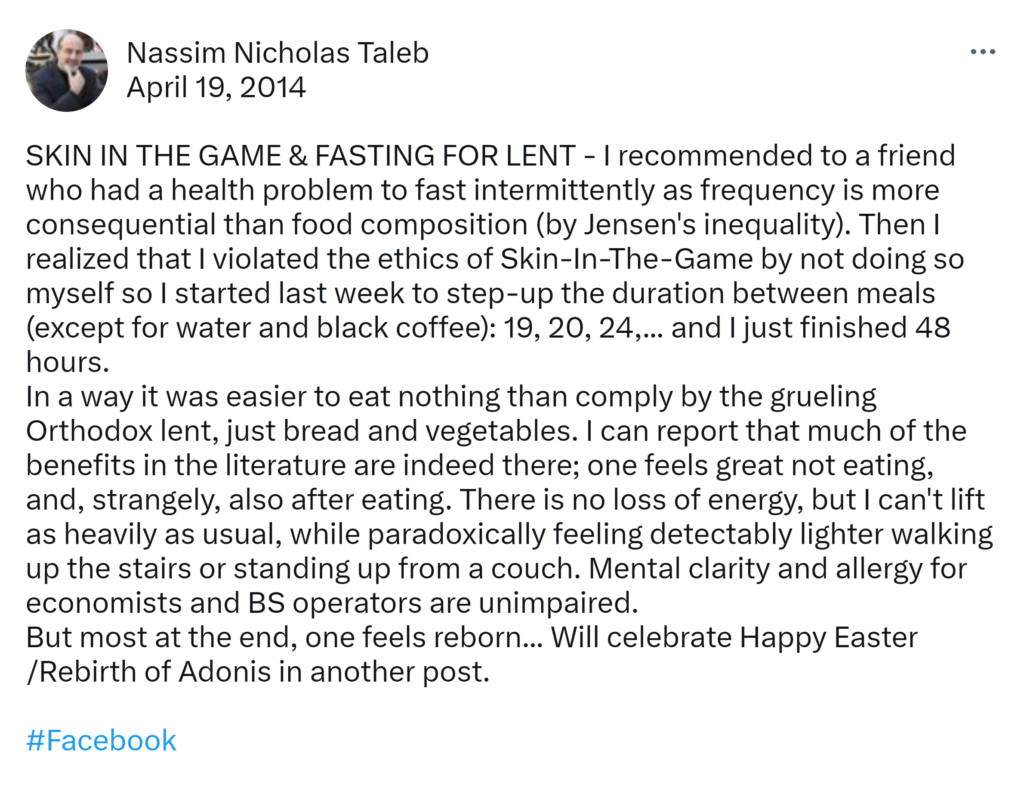
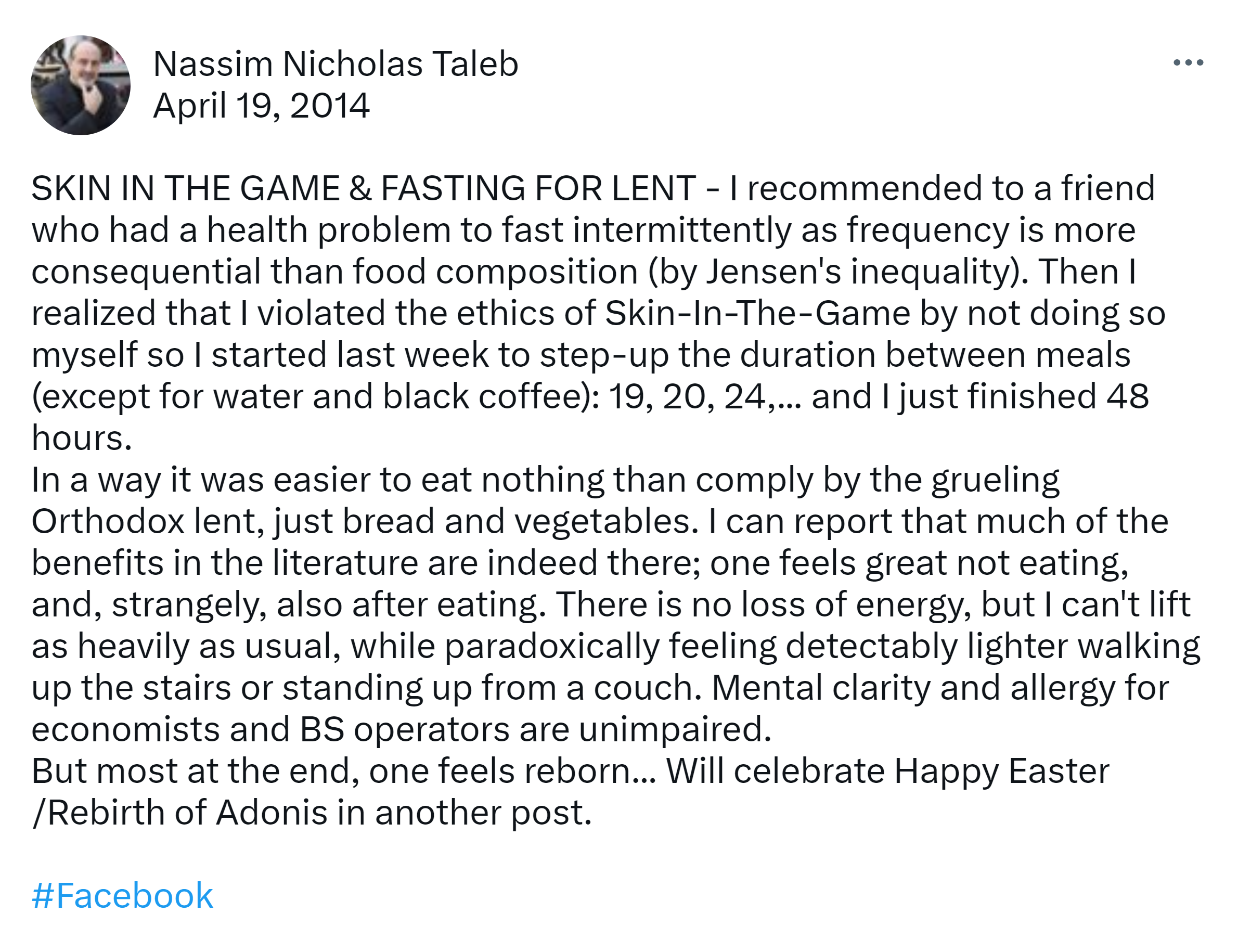
Nassim Nicholas Taleb April 19, 2014 SKIN IN THE GAME & FASTING FOR LENT – I recommended to a friend who had a health problem to fast intermittently as frequency is more consequential than food composition (by Jensen’s inequality). Then I realized that I violated the ethics of Skin-In-The-Game by not doing so myself so I started last week to step-up the duration between meals (except for water and black coffee): 19, 20, 24,… and I just finished 48 hours. In a way it was easier to eat nothing than comply by the grueling Orthodox lent, just bread and vegetables. I can report that much of the benefits in the literature are indeed there; one feels great not eating, and, strangely, also after eating. There is no loss of energy, but I can’t lift as heavily as usual, while paradoxically feeling detectably lighter walking up the stairs or standing up from a couch. Mental clarity and allergy for economists and BS operators are unimpaired. But most at the end, one feels reborn… Will celebrate Happy Easter /Rebirth of Adonis in another post.

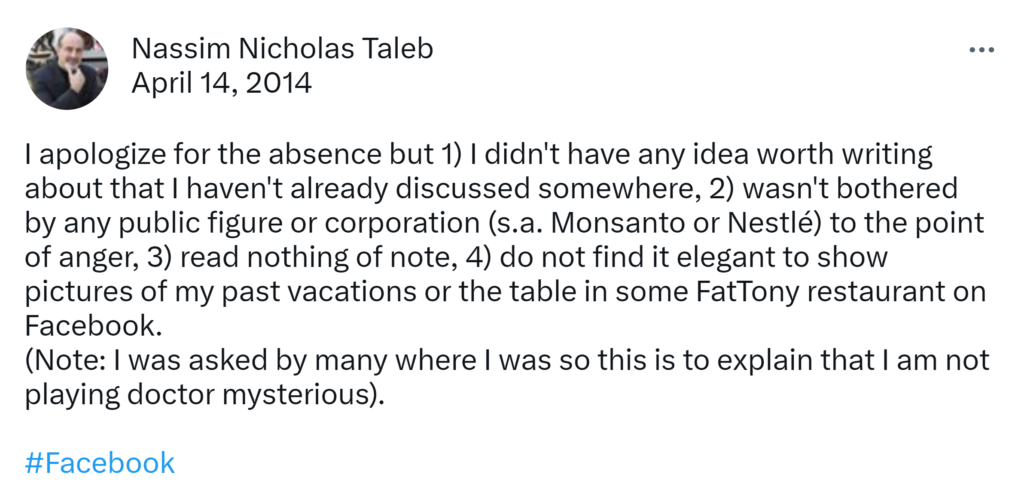
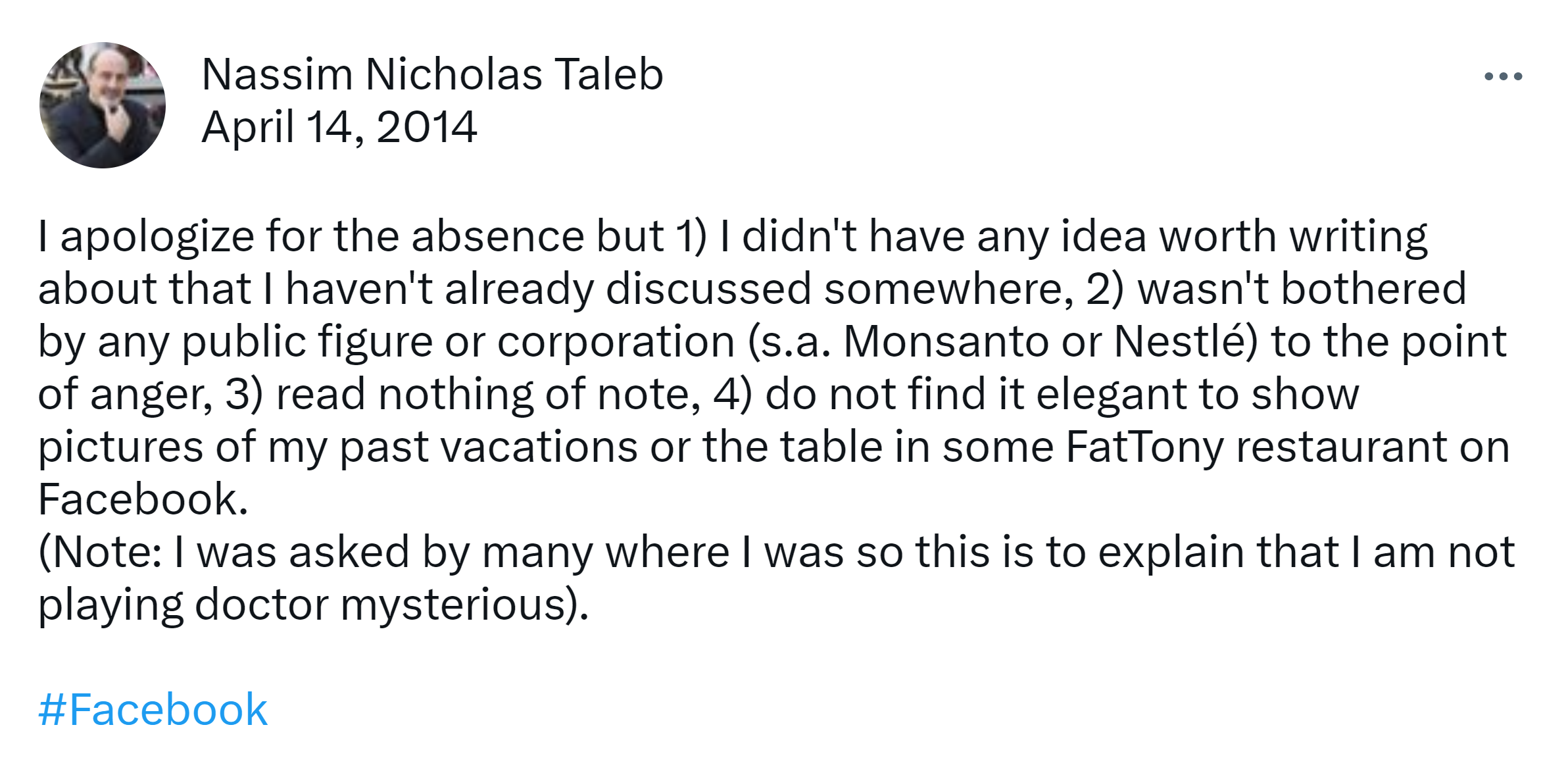
I apologize for the absence but 1) I didn’t have any idea worth writing about that I haven’t already discussed somewhere, 2) wasn’t bothered by any public figure or corporation (s.a. Monsanto or Nestlé) to the point of anger, 3) read nothing of note, 4) do not find it elegant to show pictures of my past vacations or the table in some FatTony restaurant on Facebook. (Note: I was asked by many where I was so this is to explain that I am not playing doctor mysterious).