CATEGORIES


ABOUT TALEBIBLIA

Talebiblia is a fan site devoted to Nassim Nicholas Taleb, created by Smiljana Skiba. It features a compilation of Taleb's most intriguing social media screenshots and interviews for readers to enjoy and explore. The website provides a resource for anyone looking to gain insights into Taleb's works, whether they are a dedicated reader or a curious newcomer.

Please note that Talebiblia is an independent website and is not affiliated with Nassim Nicholas Taleb in any manner.

Many thanks to Lucia Simeoni and Ashok Atluri for their invaluable assistance in creating and maintaining this website.

To stay up to date with Talebiblia's latest developments, follow Smiljana on Twitter @MasaSkiba

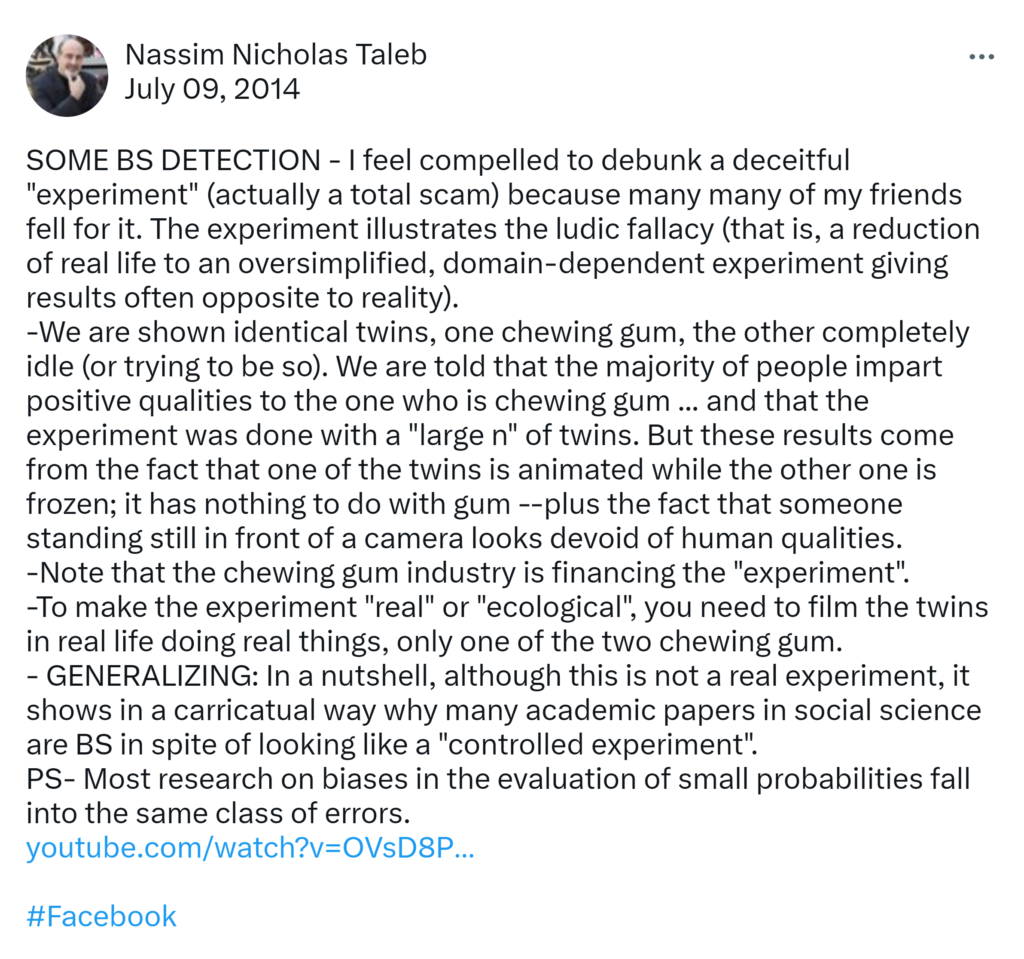
SOME BS DETECTION – I feel compelled to debunk a deceitful “experiment” (actually a total scam) because many many of my friends fell for it. The experiment illustrates the ludic fallacy (that is, a reduction of real life to an oversimplified, domain-dependent experiment giving results often opposite to reality). -We are shown identical twins, one chewing gum, the other completely idle (or trying to be so). We are told that the majority of people impart positive qualities to the one who is chewing gum … and that the experiment was done with a “large n” of twins. But these results come from the fact that one of the twins is animated while the other one is frozen; it has nothing to do with gum –plus the fact that someone standing still in front of a camera looks devoid of human qualities. -Note that the chewing gum industry is financing the “experiment”. -To make the experiment “real” or “ecological”, you need to film the twins in real life doing real things, only one of the two chewing gum. – GENERALIZING: In a nutshell, although this is not a real experiment, it shows in a carricatual way why many academic papers in social science are BS in spite of looking like a “controlled experiment”. PS- Most research on biases in the evaluation of small probabilities fall into the same class of errors.

There are two myths that prevail in academic circles (hence the general zeitgeist) because of mental contagion and confirmatory effects (simply from the way researchers look at data and the way it is disseminated): 1) That people are overly concerned by hierarchy (and pecking order), and that hierarchy plays a real role in life, a belief generalized from the fact that *some* people care about hierarchy *most the time* (most people may care about hierarchy *some of the time* but it does not mean hierarchy is a driver). The problem is hierarchy plays a large role zero-sum environments like academia and corrupt economic regimes (meaning someone wins at the expense of others) so academics find it natural so they tend to see it in real life and environments where if may not be prevalent. Many many people don’t care and there is no need to pathologize them as “not motivated” –academics who publish tend to be “competitive” and “competitive” in a zero-sum environment is deadly. I haven’t seen any study looking at things the other way. 2) That “competition” plays a large role compared to *cooperation* in evolutionary settings –of course if you want ruthless competition you will find examples and can model it with bad math. The latter point is extremely controversial, Wilson and Nowak have been savagely attacked for their papers (with >130 signatures contesting it) and, what is curious NOBODY was able to debunk the math (very very very rigorous backup material). If Nowak/Wilson were wrong someone would have shown where, and in spite of the outpour of words nobody did. (Hint: whenever I see “math” with linear regression, my BS-detector gets fired up. See commentary on “scientists” and regression in SILENT RISK)